Standards
Standards for vacuum lifting devices: EN 13155, ASME B30.20 and BTH-1 explained for buyers
Compiled from public standards and manufacturers' published data.
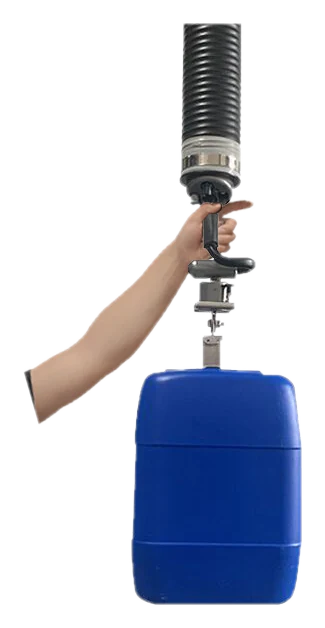
Vacuum lifting devices are covered by different documents in different markets: in Europe the harmonised standard EN 13155 under the CE regime, in North America the ASME B30.20 safety standard and the BTH-1 design standard for below-the-hook devices, and elsewhere national rules, some of which refer back to EN 13155, as Saudi Arabia's lifting equipment regulation does. This page says what each covers, which markets ask for which, what a supplier's documents should show, and how the documents for our own vacuum tube lifters fit in. It is written for buyers and EHS staff, and it is not legal advice.
Which standard applies where
| Market | Route or mark | Key standards or rules | Documents usually asked for |
|---|---|---|---|
| European Union | CE: under the Machinery Directive 2006/42/EC until 19 January 2027, under the Machinery Regulation 2023/1230 from 20 January 2027; EMC and RoHS as well | EN 13155:2020+A1:2025, EN 14238, EN ISO 12100, EN 60204-1 | EU declaration of conformity, technical file, manual in the local language, nameplate, per-unit test record |
| United Kingdom | CE recognised or UKCA for Great Britain; Northern Ireland follows EU rules; LOLER and PUWER on the user side | Supply of Machinery (Safety) Regulations 2008 | Declaration of conformity, English manual |
| United States | No federal CE-type mark; employers must use electrical equipment that is NRTL-listed or has passed a field evaluation, so buyers ask for one or the other | ASME B30.20 (applicability to tube lifters to be confirmed), ASME BTH-1, NFPA 79, NFPA 70 | NRTL mark or field evaluation report, English manual, load test certificate |
| Canada | Electrical equipment must be approved by an accredited body or special inspection | CSA C22.1 and C22.2 series | Certification or field inspection label |
| Australia and New Zealand | No single product mark; WHS duties on designers, importers and suppliers | AS 4991-2004 for below-the-hook devices including vacuum lifters | Design and risk information, manual, electrical safety to AS/NZS 3820 |
| Saudi Arabia | SABER platform; the SASO lifting equipment regulation lists heading 8428 and refers to EN 13155, so a Type 1a certificate, a supplier's declaration of conformity and a risk assessment are likely to be needed; confirm with a SABER lookup on the actual tariff code | SASO machinery safety regulations | Certificates as applicable, technical file, Arabic labels and manual (to be confirmed) |
| Brazil | NR-12 applies to manufacture, import and sale of machinery | NR-12, NR-11 | Portuguese manual, nameplate, NR-12 technical file |
The table is a summary for orientation; whether a rule applies to a given shipment should be confirmed in writing by the importer or a certification body in the destination market. The documents we supply for a specific model and market are listed in the quotation. What buyers commonly ask for, market by market, is also on the factory and documents page.
EN 13155: non-fixed load lifting attachments in Europe
EN 13155 (Cranes – Safety – Non-fixed load lifting attachments) is the European standard for lifting attachments that are not a permanent part of the crane, and vacuum lifters are inside its scope. The current version is EN 13155:2020+A1:2025, listed in the Official Journal as a harmonised standard under the Machinery Directive in March 2026 by implementing decision (EU) 2026/546; the 2020 edition without the amendment was never listed, and the old 2003+A2:2009 edition is being withdrawn. A manufacturer's EU declaration of conformity that still cites EN 13155:2020 should be updated to the +A1:2025 version.
| Clause topic | Requirement in brief |
|---|---|
| Adhesion force | At least 2 times the working load limit at the low end of the working vacuum range |
| Vacuum gauge | Shows the working and the danger zones and stays visible to the operator |
| Loss of vacuum | A measure against it, such as a non-return valve between pump and reservoir |
| Warning device | Audible and visual warning when the vacuum falls into the danger zone, still working after a power failure; British guidance sets the alarm at 80% of normal working vacuum |
| Holding time | The load held for at least 5 minutes after the energy supply is interrupted |
| High-risk areas | Two independent vacuum circuits or a secondary mechanical hold |
| Release | A two-action control to release the load |
| Manual | Vacuum checks, action after an alarm, hose and pad inspection, holding time after power failure, noise limits for the alarm to be heard, and the conditions the rating was verified under |
Tube lifters have their own case. The lifting tube's cross-section is about half the pad area, so the holding force is naturally about twice the lifting force; when the pump fails, the non-return valve at the top of the tube closes and the load does not drop at once, but comes down slowly as the vacuum decays. Whether the five-minute holding clause applies to a tube lifter as written, or a controlled descent is accepted instead, is not settled in the secondary sources; ask the manufacturer how its technical file deals with that clause.
EN 13155 covers the lifting attachment; EN 14238 covers power-assisted, manually guided manipulating devices as a whole; British guidance cites both for vacuum lifting equipment. In the European route a tube lifter is machinery outside the high-risk annex, so the manufacturer may self-assess under internal production control, sign the declaration and affix the CE mark; a notified body is not required, and a voluntary third-party review is a commercial extra, not a legal step.
ASME B30.20 and BTH-1: below-the-hook devices in North America
ASME B30.20 is the safety standard for below-the-hook lifting devices; the 2025 edition was published on 30 April 2025 and became effective one year after publication; its chapter 20-2 covers vacuum lifting devices. ASME BTH-1 is the companion design standard, and nameplates are reported to carry the BTH-1 design category and service class. OSHA uses B30.20 as its reference when it inspects below-the-hook devices.
Condition: B30.20 is written for devices that connect a load to a hoist. A vacuum tube lifter lifts with the tube itself rather than hanging from a hoist hook, so whether it falls fully inside the scope is not settled in the material we have; we do not claim B30.20 conformity for our lifters, and a buyer who needs it should put the question to the manufacturer and the inspector in writing. What the standard does give every buyer is a test and inspection frame: a test load for vacuum lifting devices of not more than 125% of the rated load, plus 5% and minus 0%, and inspections before each use, frequent inspections from daily to monthly and periodic inspections from quarterly to yearly depending on how hard the device is used.
Electrical approval is a separate matter in North America: in the United States the control panel or the whole machine needs NRTL certification or a field evaluation, and in Canada certification by an accredited body or a special inspection; a CE mark does not stand in for either.
Other references: EN 14238, ISO 11228-1 and the Machinery Regulation
Three documents are often mixed up with the two above. EN 14238 is the standard for the manipulating device as a whole, as distinct from the attachment that grips the load. The Machinery Regulation (EU) 2023/1230 replaces the Machinery Directive from 20 January 2027; each unit is judged by the date it is placed on the market, and a unit placed on the market from that date needs a declaration under the Regulation. Standards listed under the Directive do not automatically give a presumption of conformity under the Regulation, and which standards are listed under it is still to be checked. ISO 11228-1 is an ergonomics standard about people, giving recommended limits for lifting, lowering and carrying by hand; it tells you whether a task needs an aid, not how the aid is built. On the user side, the United Kingdom's LOLER requires a thorough examination at least every 6 months for lifting accessories and every 12 months for other lifting equipment, or under a written scheme of examination; which applies to a tube lifter is for the competent person to decide. In Australia, AS 4991-2004 is the product standard for lifting devices that hang from a crane or hoist hook, vacuum lifters included.
Next step: the safety functions these standards describe, and how a tube lifter behaves when the power fails, are explained on how a vacuum tube lifter works.
What to ask a supplier for
- A signed declaration of conformity citing the current standard versions, EN 13155:2020+A1:2025 among them for Europe
- A technical file summary and a commitment to keep the file available for at least 10 years
- A risk assessment in the EN ISO 12100 format
- A per-unit load and function test certificate tied to the serial number, recording the working load limit, test load and method, working vacuum and alarm points, holding or controlled-descent time on power failure, alarm test, and the inspector's signature and date
- The manual in the destination language, with the vacuum checks, alarm response and holding time the standard asks for
- Nameplate drawing, electrical diagrams and component list; certificates for key components; EMC and RoHS documentation for Europe and the United Kingdom; NRTL marking or a field evaluation plan for the United States
Next step: the documents we post or send are listed on the data sheets and documents page.
How our documents fit
Our vacuum tube lifters are CE marked, with Attestation of Conformity No. CE-1629-01-011123 (CGS Test, valid to 2028) available on request. The quotation lists the other documents we supply for a given model and market, including the language of the manual, and says whether a per-unit test certificate comes with the lifter. We do not state conformity to ASME B30.20 or BTH-1, and we do not offer explosion-protected versions.
FAQ
Does a CE mark mean the lifter meets ASME B30.20?
No. CE is a European conformity mark under the machinery rules; B30.20 is a North American below-the-hook standard, and US electrical acceptance needs an NRTL certification or a field evaluation in any case.
Who does the verification test?
In the European route no third party is required: the manufacturer is responsible for the tests and the records, keeps them in the technical file and signs the declaration; a third-party review is optional and does not replace the manufacturer's declaration and technical file.
A standard has a new edition. Does the lifter need re-certifying?
For a CE-marked machine outside the high-risk annex no notified-body certificate is required, so there is nothing to re-certify by law; the manufacturer reviews the technical file against the new edition and updates the declaration. The declaration should cite the editions current when the unit is placed on the market; EN 13155:2020+A1:2025 was listed in March 2026, so a declaration still citing EN 13155:2020 should be updated. For our lifters, the documents supplied are listed in the quotation.
state the destination market and we list the documents that come with it.
Scope
What this page does not cover
This page is not legal advice; glass and stone vacuum lifters are outside this site's range, and explosion-proof versions are not offered; the standards' own texts are paid documents and are summarised here from secondary sources.
Cowest Machinery designs and manufactures vacuum tube lifters at its factory in Qingyuan, Guangdong, China.