Vacuum needs a face to seal on and a load that stays put. Open-top boxes, totes with loose contents, cartons whose contents shift, and off-centre loads either give the pad nothing to hold or tip as they lift. Half-filled or sagging cartons behave like loose sacks: the top deforms under the pad and the seal breaks.
Vacuum Box Lifter
Vacuum box lifter for cartons, cases and totes
A vacuum box lifter picks a carton by its top face and lets one operator move it from pallet to conveyor, shelf or cage without bending or carrying. Our single-handle ESL-SG and compact ESM lifters cover cartons up to about 60 kg, and the two-handle ESL-MD takes heavier cases; this page covers which cartons lift well, which model and pad to choose for the box weight, how e-commerce picking stations are set up and where vacuum reaches its limits. Sacks, drums and panels are set out by load type on the other load types page.
- Six carton bands, from about 18 kg to about 90 kg
- SFD and HB carton pads on the ESL-SG, ESL-MD and ESM
- Mobile units for picking at several docks
- Double pads for split tops: industry practice, availability confirmed when quoting
Cartons are planned at about 75% of a lifter's rating until your own cartons are tested, and open-top boxes or loose contents are tested rather than assumed to work.
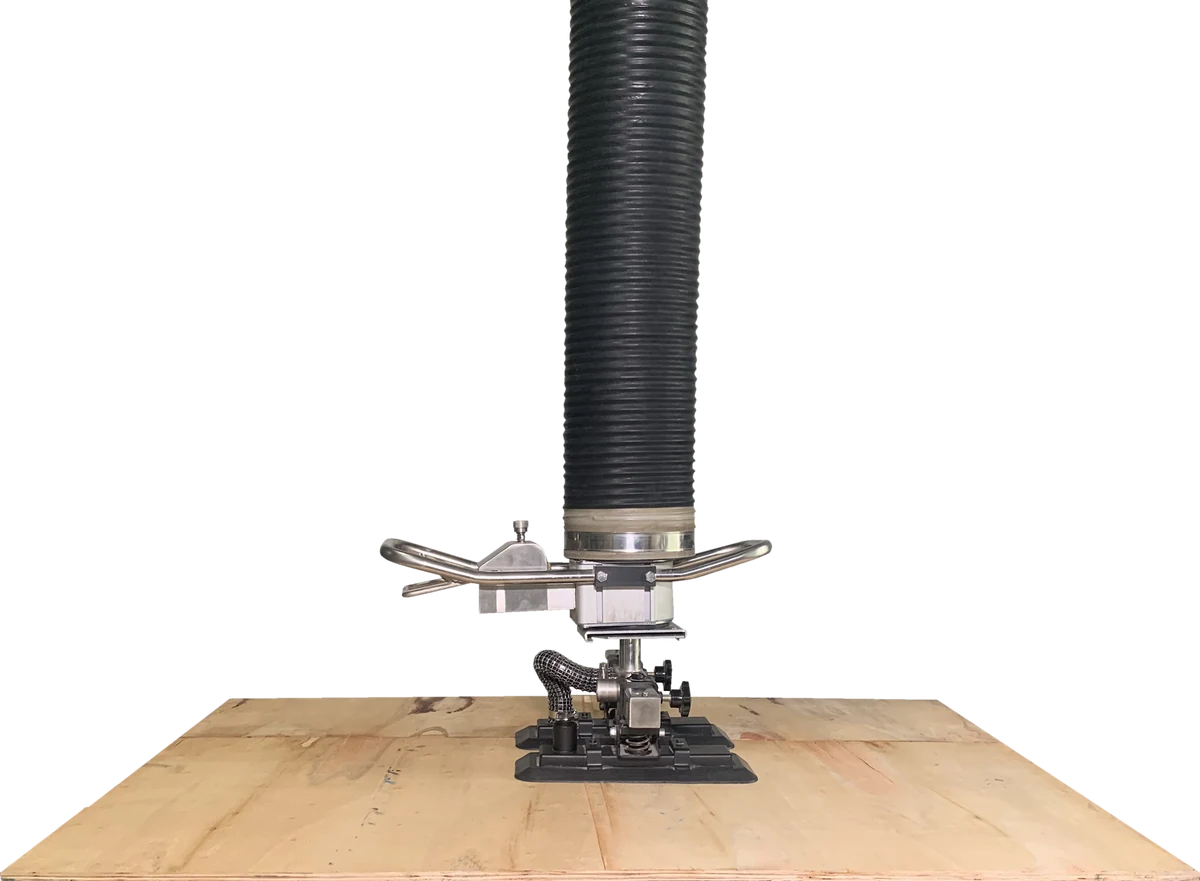
- Carton weight:
- up to about 90 kg
- Carton pads:
- SFD / HB
- Planned at:
- about 75% of rating
- Lifting height:
- 1,700 or 2,500 mm
Carton types
Carton types and what the pad needs
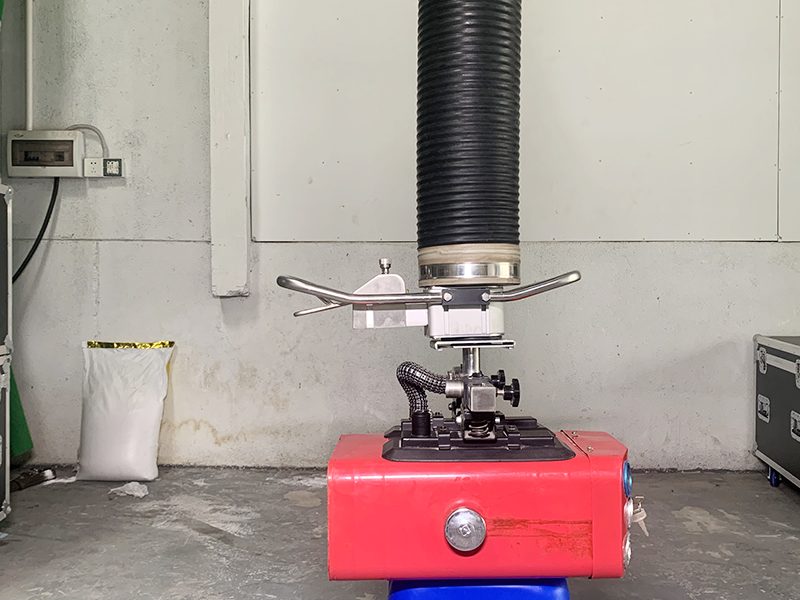
| Carton | What happens under vacuum | Pad and setup |
|---|---|---|
| Taped carton with a flat top | Seals well; semi-porous, 75–90% of rated capacity | Carton pad SFD or HB, sized so the seal sits inside the top face |
| Split-top carton (two flaps meeting in the middle) | A single pad bridges the gap and leaks | Double pad, one cup on each flap; availability and size confirmed in the quotation |
| Open-top box, tote or tray | Little or no top face to seal on | Often not suited to vacuum; a fork- or tray-type tool or a mechanical gripper is the usual alternative; test first |
| Heavy carton lifted by the lid only | The lid or the top liner can peel or tear | Keep the pad well inside the lid, size the lifter with margin, and consider lifting the case from a stronger face |
Recommended setup
Recommended setup by carton weight
For semi-porous cartons we size the lifter on about 75% of its rated capacity, the conservative end of the derating range. The table reads that way: the carton weight is the planning figure, confirmed by a test with your own cartons; the rated capacity is the catalogue value for airtight loads.
| Carton weight up to | Lifter model | Rated capacity (airtight) | Operation | Pad |
|---|---|---|---|---|
| 18 kg | ESM25 compact | 25 kg | One-piece handle, 90° tilt, 360° rotation | SFD / HB carton pad |
| 26 kg | ESM35 compact or ESL-SG120/22 | 35 kg | Compact with tilt, or single-handle for speed | SFD / HB |
| 33 kg | ESL-SG140/22 | 45 kg | Single-handle, stainless-steel handle | SFD / HB |
| 45 kg | ESL-SG160/30 | 60 kg | Single-handle | SFD / HB |
| 60 kg | ESL-MD180/30, or ESL-SG180/30 (80 kg per catalogue) | 80 kg | Usually two-handle; ESL-SG180/30 for occasional lifts | SFD / HB |
| 90 kg | ESL-MD200/40 | 120 kg | Two-handle, optional 90° tilt | SFD / HB |
The ratings in this table are catalogue values for airtight loads, and the carton weights next to them come from the 75% planning figure until your cartons are tested. All models lift 1,700 mm; the ESL series also comes with 2,500 mm lifting height, chosen when the height difference between pick and place exceeds about 1.5 m, which is the 1,700 mm stroke less about 0.2 m to clear the stack.
Picking
E-commerce and 3PL picking stations
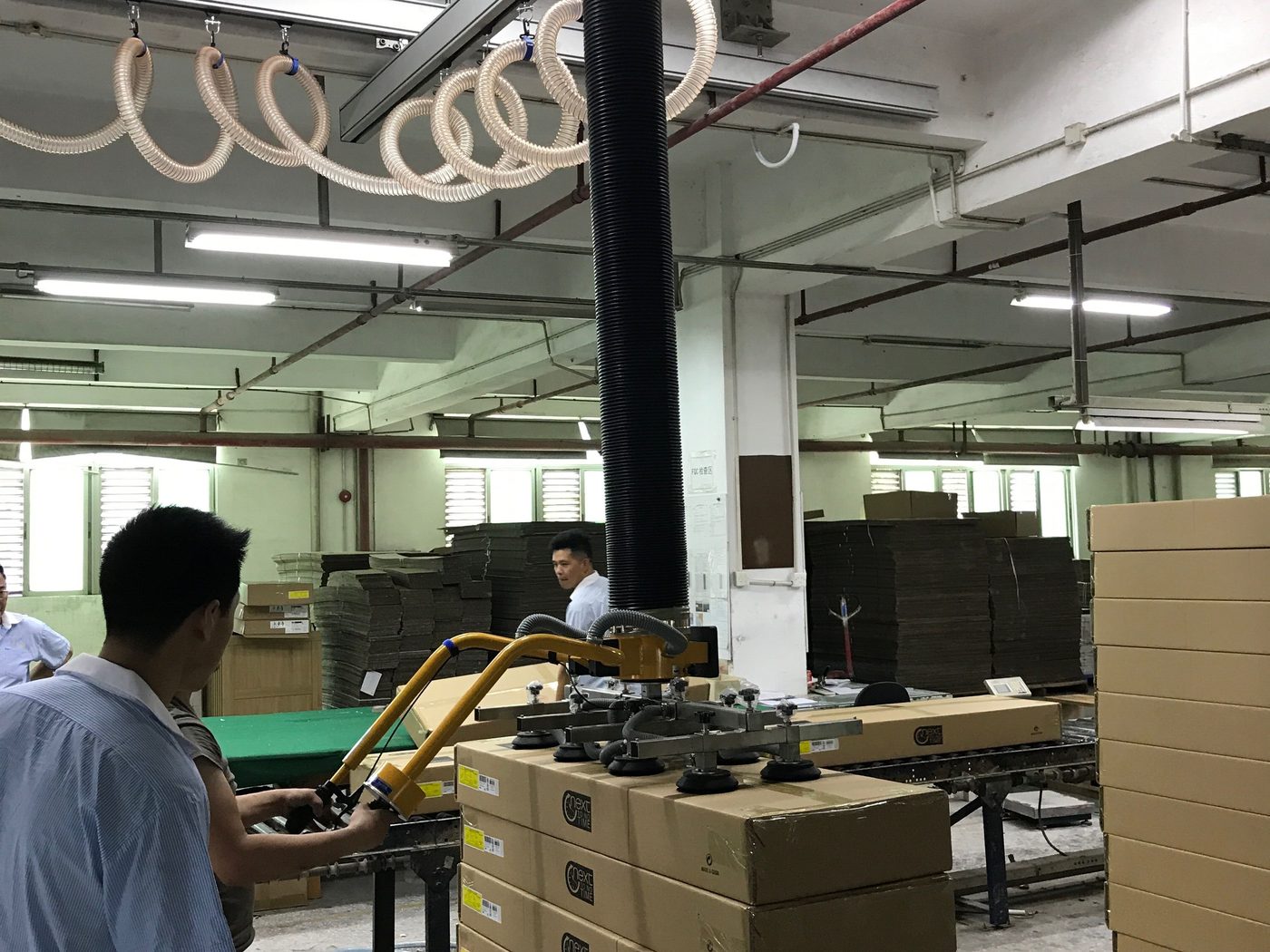
Picking stations handle 5–50 kg cartons at a high rate with sizes that change from order to order, from floor pallets and from racking. A typical setup is a single-handle lifter in the 35–60 kg class, for cartons up to about 45 kg (heavier cartons: see the table), on an aluminium rail or a jib crane over the station, with a carton pad sized for the smallest box and the 2,500 mm lifting height where the pick-to-place height difference exceeds about 1.5 m.
Where several docks or aisles share one lifter, a battery-powered mobile unit avoids a crane at each position: MD units are pushed and AD units are self-propelled at 5.5 km/h, both with a 3 m arm and 45 or 60 kg rated capacity, used inside the building and kept stationary while lifting. Mobile units need no floor installation, though the floor has to carry the loaded unit. Planned at 75%, those ratings suit cartons of about 33 or 45 kg, and the carton pad for a mobile unit is confirmed in the quotation.
Condition: at high rates the pad and the quick-release matter as much as the capacity; the ESL-MD's quick-release valve cuts set-down time, while the ESL-SG keeps one hand free to steer. Next step: for picking at several docks, see the mobile vacuum lifters. For stacking cartons onto pallets by hand, see manual palletizing of boxes.
Layout
Layout example
Worked example (example figures, not a customer case): taped cartons of 300×200×200 mm to 600×400×400 mm weighing up to 30 kg, picked from floor pallets and racking up to 1.8 m, about 120 lifts an hour, some placed on their side with the label out.
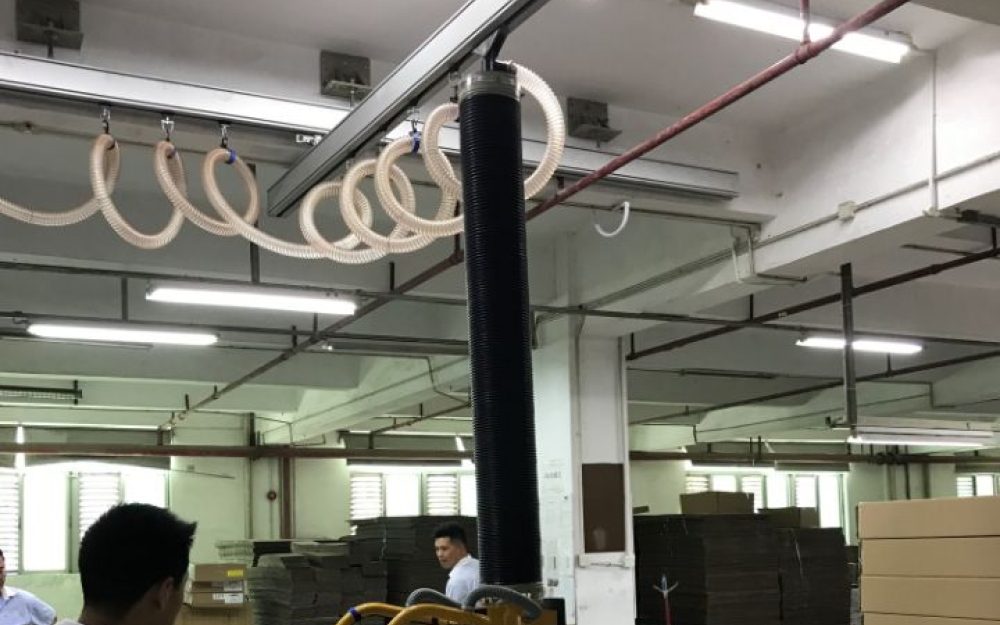
Capacity:
a 30 kg semi-porous carton needs about 34–40 kg of airtight rating, so a 45 kg single-handle unit is the starting point.
Side placement:
because the tilt rating is lower, the label-out cartons go to a larger ESL-MD with the 90° tilt option, sized on the factory's tilt rating in the proposal.
Pad:
the smallest top face, 300×200 mm, sets the pad size.
Stroke:
from a floor pallet to 1.8 m is a height difference of about 1.65 m, which with 0.2 m to clear the stack exceeds the 1,700 mm stroke, so the 2,500 mm lifting height is chosen; for racking beyond that, ask us.
Risk:
lifting a 30 kg carton by the lid alone can peel a weak lid; for split-top cartons the usual industry answer is a double pad, and whether we supply one is confirmed in the quotation.
Limits of vacuum
Open-top and unstable boxes
What helps: a pad placed over the centre of gravity, a double pad to spread the grip, a swivel that keeps the tube vertical, or lifting the box by a stronger face. What does not help is more vacuum; a torn lid tears faster. When in doubt, send sample cartons and we test them before quoting.
FAQ
How heavy a carton do these setups take?
Up to about 90 kg: planned at about three quarters of the rating, the cartons run from about 18 kg on the 25 kg-rated ESM25 to about 90 kg on the 120 kg-rated ESL-MD200/40; heavier cases are a question for us.
How many cartons an hour at a picking station?
The walk between pick and place and how precisely each box must land set the pace; the ESL series lifts at up to 0.8 m/s, and we estimate your rate from the station layout rather than quote a general figure.
How much headroom does it need?
The highest place point plus the retracted lifter plus the crane or rail; the figure for your model comes from the factory drawing.
Scope
What this page does not cover
Glass and stone vacuum lifters are outside this site's range, and no setup on this page is offered for open or loosely filled boxes before a test. The range ends at 200 kg, and none of it is explosion-proof.
Cowest Machinery designs and manufactures vacuum tube lifters at its factory in Qingyuan, Guangdong, China, founded in 2008; the lifters are CE marked, with Attestation of Conformity No. CE-1629-01-011123 (CGS Test, valid to 2028) available on request.
Get a selection proposal
carton sizes and weights, pick and place heights, lifts per hour, power supply and a photo of the station are all we need.