Porous sacks are lifted every day, but they are sized differently. The blower has to replace the air leaking through the paper while still holding the vacuum, so for porous loads the first lever is a higher-flow blower; on our ESL range the blower is fixed by the model, from 2.2 to 5.0 kW, and the model is confirmed from the sample test. A larger lifting tube on its own adds weight and cost while the leak stays the same.
Vacuum Bag Lifter
Vacuum bag lifter for 25 kg and 50 kg sacks
A vacuum bag lifter lets one operator take a 25 kg or 50 kg sack off a pallet, swing it to a conveyor, hopper or stack and set it down without bending or carrying it. Below: which sacks lift well on vacuum, the ESL model and pad for each bag weight, what changes for porous paper, how four industries use it, a palletising layout, the national lifting limits a 25 kg sack runs into, and a payback example. Cartons and drums have pages of their own; the other load types are listed on the applications overview.
- Sack weights from 25 to 50 kg
- Film, lined, laminated and plain paper sacks
- ESL-SG one-hand lifters for quick 25 kg cycles, ESL-MD for sacks to 50 kg with a 90° tilt to order
- Sample test for porous paper before the model is fixed
Uncoated woven, jute and cloth sacks are not taken for granted on vacuum: they are tested first, and if vacuum will not hold them, a mechanical gripper is what plants in the industry normally use.
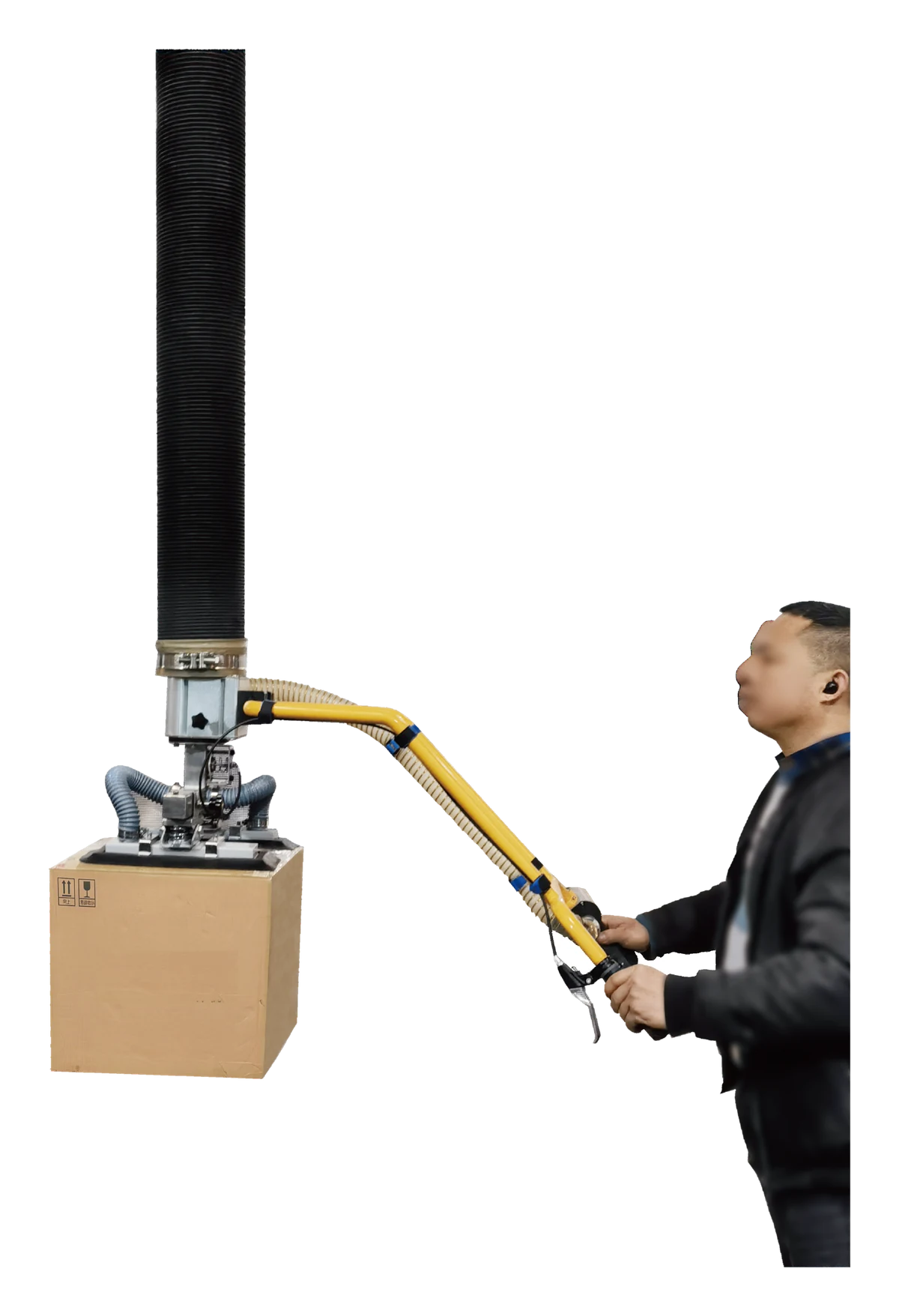
- Sack weight:
- 25–50 kg
- Sack pad:
- SUS230×380R on 45–80 kg models
- Unlined paper:
- typically 50–80% of rating
- Lifting height:
- 1,700 or 2,500 mm
Sack types
Which bags a vacuum lifter can handle
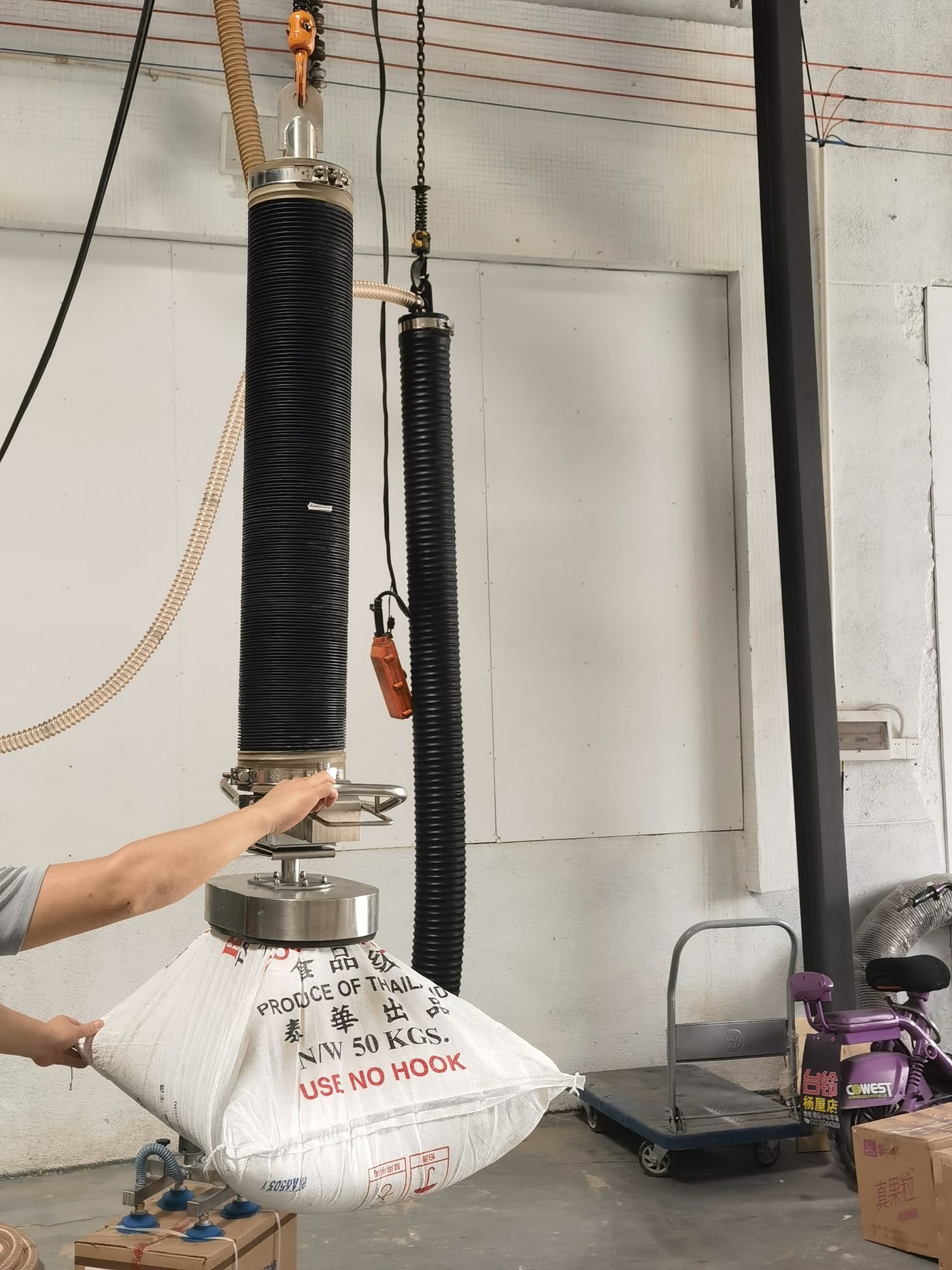
| Sack type | Porosity class | Vacuum lifting | Typical capacity vs rated | Note |
|---|---|---|---|---|
| PE film bag (plastic pellets, salt, sugar) | Airtight | Yes | 100% | Smooth film can slide; pad must sit flat |
| Lined paper sack, or laminated woven bag | Semi-porous | Yes | 75–90% | Standard sack pad with foam seal |
| Multi-wall paper sack without liner (flour, cement) | Porous | Yes, with high-flow blower | 50–80% | Sample test before order |
| Uncoated woven PP, jute, cloth bag | Highly porous | Often not on vacuum alone | — | Tested before any quote; where vacuum fails, industry practice is a mechanical sack gripper |
Recommended setup
Recommended setup by bag weight
For airtight and semi-porous sacks the choice is simple: pick the lifter whose rated capacity covers your heaviest bag with margin, then match the pad to the bag size. For porous paper sacks apply the derating in the table above first, then choose the model.
| Bag weight | Lifter model | Rated capacity | Sack pad | Blower | Lifting height |
|---|---|---|---|---|---|
| Up to 25 kg, high cycle, one hand | ESL-SG140/22 | 45 kg | SUS230×380R | 2.2 kW | 1,700 or 2,500 mm |
| Up to 25 kg, two-hand control | ESL-MD140/22 | 45 kg | SUS230×380R | 3.0 kW | 1,700 or 2,500 mm |
| 25–40 kg | ESL-MD160/30 | 60 kg | SUS230×380R | 3.0 kW | 1,700 or 2,500 mm |
| 40–50 kg | ESL-MD180/30 | 80 kg | SUS230×380R | 4.0 kW | 1,700 or 2,500 mm |
| 50 kg porous paper sack | ESL-MD200/40 | 120 kg | Confirmed in the quotation | 5.0 kW | 1,700 or 2,500 mm |
The capacities in this table are catalogue ratings, given for airtight loads; for paper or laminated woven sacks, multiply them by the 'Typical capacity vs rated' share in the sack table above, which the sample test then confirms. ESL-MD lifters include a quick-release valve and can be supplied with a 90° tilt for emptying sacks into a hopper; tilting reduces the rated capacity and the tilt rating is confirmed in the quotation. The ESL-SG series has a stainless-steel one-hand handle for fast picking.
Porous sacks
Porous paper sacks: derating and sample test
For the test, three to five of your own sacks come to our factory and are lifted on a lifter and pad of the proposed size; you get the video before you order, and the test settles the usable capacity, the pad size and whether the pad needs a support mesh or a skirt seal. Test conditions are agreed with the quotation.
Industries
By industry: flour, feed, plastics, cement
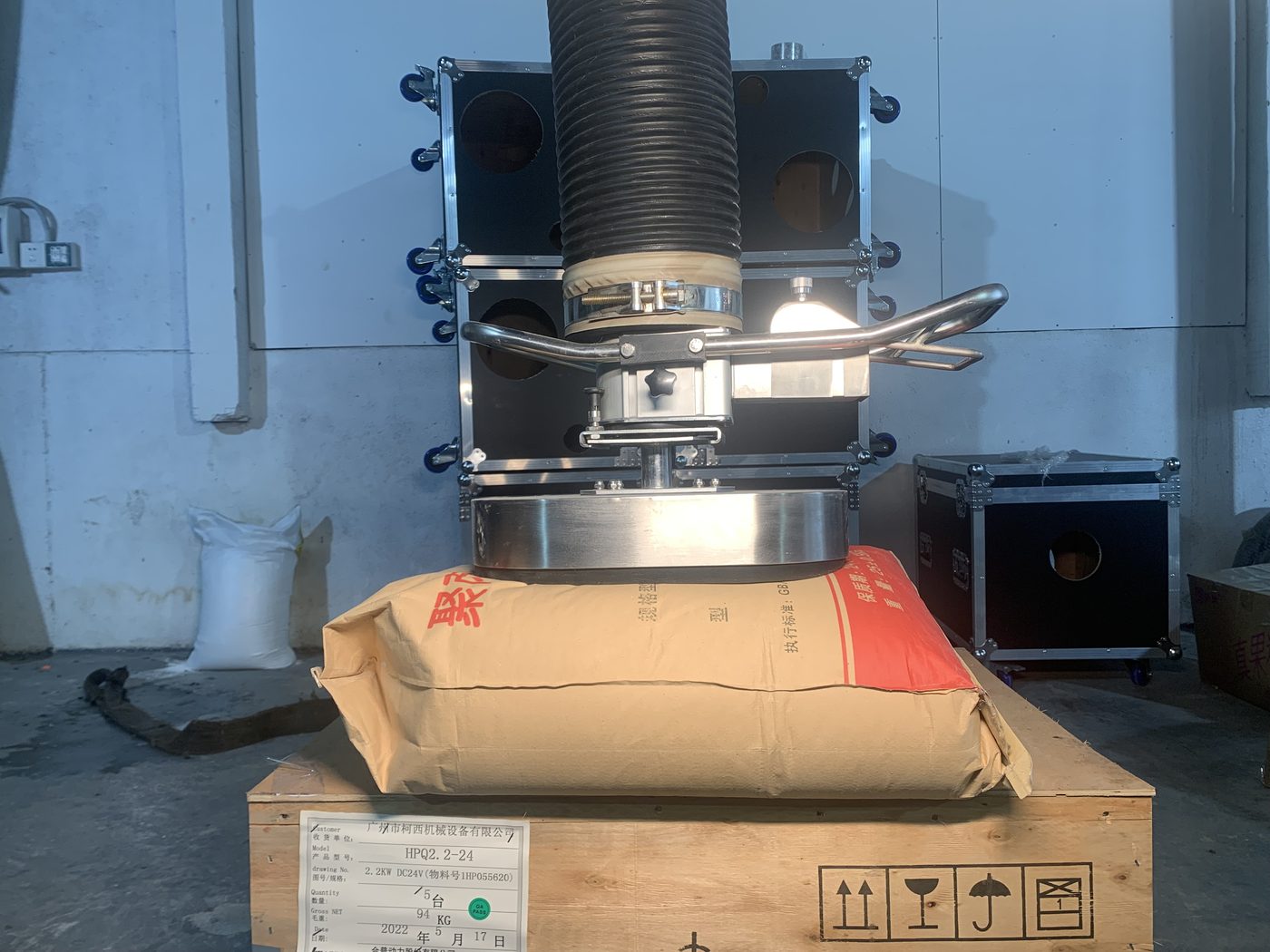
In flour, feed, plastics and cement plants the sack is the same 20–50 kg, but each industry brings its own dust, hygiene or zone question.
Next step: in the selection form, state the product, the bag material and whether the area is a classified hazardous zone; those three answers decide most of the configuration.
-
Flour, sugar and milk powder
Food plants typically handle 25 kg paper sacks of flour, sugar, milk powder and spices from pallet to mixer or hopper. For unlined paper sacks start from the 60 kg class with a sack pad with support mesh; a 45 kg lifter is enough for lined sacks or where the sample test shows it; at a dosing station a longer handle is often added. Two conditions apply. Flour, sugar, milk powder and spices are combustible dusts, so the area around a dump station may be classified as a hazardous zone; our lifters are the standard version and are not for explosive atmospheres, so tell us the zone classification before we quote. If the pad will touch unpacked food, say so in the form: a food-contact configuration is offered only where the manufacturer's material declarations are available.
-
Feed, seed and fertiliser
Feed and agriculture mean 25–50 kg sacks, a high share of woven bags and seasonal peaks. Paper and laminated woven sacks run on a sack pad with a high-flow blower; uncoated woven and jute sacks often cannot be held by vacuum alone, so we test a sample first and tell you if vacuum will not hold; a mechanical gripper is the usual alternative in the industry. Whether grain and feed dust is zoned at your plant is for your safety officer to confirm.
-
Plastic pellets and chemicals
Plastic compounders and chemical plants mostly lift 25 kg PE film bags of pellets or paper sacks of powders, often up into a mixer or reactor. PE film is airtight, so the lifter works at its rated capacity; the practical issue is that the film is smooth and the pad must sit flat on the bag. Solvent or dust zones again rule out the standard version, and corrosive products are discussed before quoting.
-
Cement, mortar and tile adhesive
Building-material sacks weigh 20–50 kg depending on the country, and the environment is heavy dust with abrasive bag surfaces. For cement sacks we recommend a wear-resistant seal (natural-rubber foam is common in the industry) and a larger dust filter; seal material and filter options are confirmed in the quotation, and we suggest ordering spare seals and filter cartridges with the lifter because they wear faster here. Plain paper cement sacks are porous and are derated like other paper sacks.
Layout
Palletizing and depalletizing layout
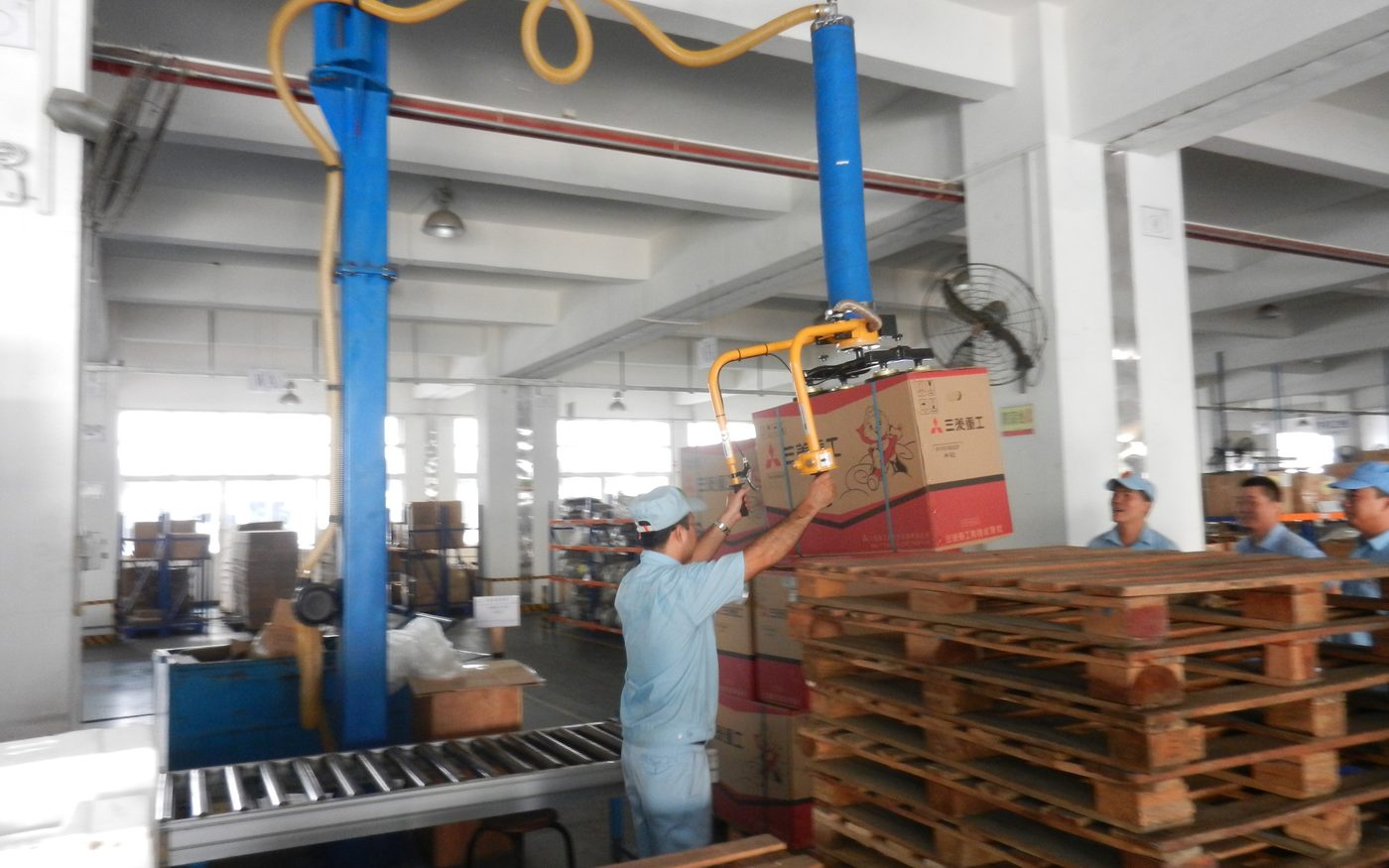
A sack lifter is only as fast as the layout around it, and three numbers decide the installation: the deepest point the pad must reach, the highest place point and the radius the operator must cover. In the worked example below, 25 kg paper sacks arrive on a conveyor at 0.8 m and are stacked on a pallet up to 1.8 m, 600 sacks a day in one shift; the figures illustrate the method and are not a customer case.
Stroke:
the pad has to reach about 0.28 m for the first layer and place at 1.8 m; with 0.2 m to clear the stack that is about 1.72 m, tight for a 1,700 mm lifting height, so the 2,500 mm version is recommended.
Crane:
one column with a 3.5 m arm reaches the conveyor and both pallets; our WJC range has 2.5–4.0 m arms in 125 and 250 kg classes, with the foundation drawing supplied with the order.
Rate:
600 sacks a day is about 80 an hour, well inside what a tube lifter does at several lifts a minute, so pallet changes, not the lifter, set the pace.
25 kg sacks and the law
Against national lifting limits, a 25 kg sack sits at or over the ceiling for one person in most of the markets we ship to, and a 50 kg sack is over it nearly everywhere; the limits are ceilings for lifting without aid, not safe values. Most rules also ask the employer to assess posture, frequency and distance.
| Country and basis | Limit (men / women) | 25 kg sack | 50 kg sack |
|---|---|---|---|
| Mexico, NOM-036 (regulation) | 25 / 20 kg (women 45+: 15) | At the limit (men 18–45); over (women) | Over |
| Chile, "Ley del Saco" (law) | 25 / 20 kg | Men: 25 kg only if mechanical aids cannot be used; women: over | Over |
| Colombia, Res. 2400 (regulation) | 25 / 12.5 kg | At the limit (men); twice the limit (women) | Over |
| Peru, RM 375-2008-TR (regulation) | 25 / 15 kg | At the limit (men); over (women) | Over |
| Brazil, CLT and NR-17 (law) | 60 / 20 kg continuous, 25 occasional | Allowed for men, NR-17 assessment applies; women: over if continuous, at the cap if occasional | High risk (men); over (women) |
| Malaysia, DOSH 2018 (guideline) | 25 / 16 kg | At the guideline (men); over (women) | Over |
| Thailand, regulation 2004 | 55 / 25 kg | At the limit (women) | Over (women) |
| United Kingdom, HSE (guidance) | 25 / 16 kg | At the screening value (men); over (women) | Over; full assessment |
| NIOSH equation (method) | 23 kg load constant | Over, even in ideal conditions | Far over |
Payback
ROI example
The payback of a sack lifter comes mostly from labour: a 50 kg sack that two people carry today is a one-person job with a lifter. The method is simple: total investment divided by yearly net benefit, where the benefit is saved labour plus avoided injury and absence cost plus any throughput gain, and the running cost is electricity, wear parts and maintenance.
Condition: the example assumes a two-shift plant at US$8,000 per operator per year and counts the throughput gain as zero. Where nobody is taken off the station, the labour line is zero and the payback runs to several years; the investment is then a safety, retention and customer-audit case rather than a labour case. We fill this table with your figures in the selection proposal.
Next step: the figures you need are the number of operators at the station, shifts, yearly cost per operator and your own injury history; send them with the form and the table comes back filled in.
| Item | Example value | Result |
|---|---|---|
| Lifter (50 kg class) with pillar jib crane, FOB | US$7,500 | |
| Freight and insurance; import duties and clearance | US$600; US$900 (duty rate depends on country) | |
| Installation, commissioning and training | US$1,000 | Investment I = US$10,000 |
| Labour saved: 2 shifts, one person fewer per shift, US$8,000 per person per year | 2 × 8,000 | 16,000 |
| Injury and absence cost avoided: one back injury a year at US$4,000, counted at 50% | 4,000 × 50% | 2,000 |
| Throughput gain | counted as 0 | 0 |
| Staff turnover: one fewer leaver a year at US$800 | 800 | 800 → Benefit B = 18,800 |
| Electricity: 3 kW (as in the source example) × 16 h × 300 days at US$0.12/kWh | 14,400 kWh | 1,728 |
| Wear parts and maintenance | 600 | Running cost C = 2,328 |
| Net yearly benefit N = B − C | 16,472 | |
| Payback = I ÷ N × 12 | about 7.3 months | |
| Three-year ROI = (3N − I) ÷ I | about 394% |
FAQ
Will it lift unlined paper sacks?
Yes in most cases, on a model chosen one size up and a sack pad that suits the bag; the leak through the paper lowers capacity and speed, and a sample test with your own sacks shows the effect before you order.
How many sacks an hour can one lifter handle?
It depends on the walk between pick and place and how exactly each sack has to sit; several lifts a minute is a common figure for short palletising runs, not a promise, and we work out your rate from the layout.
Is it suitable for a food plant?
Handling packed food in sacks is a common application. If the pad touches unpacked food, food-contact pad materials and a hygienic design are required; we offer such a configuration only with the manufacturer's material declarations. Flour and sugar dust zones are a separate question; see the industry section above.
Do half-filled sacks lift?
A slack sack is drawn into the pad unless the pad has an internal support mesh; tell us the fill level, and whether we supply a mesh pad for your sack is confirmed in the quotation.
Scope
What this page does not cover
Bulk bags (FIBC) and big-bag lifters, bag-splitting stations and automatic palletisers are outside this page. We offer no explosion-proof version, so dump stations in a classified dust zone are not for our lifters, and nothing above 200 kg is in our tube lifter range.
Cowest Machinery designs and manufactures vacuum tube lifters at its factory in Qingyuan, Guangdong, China, founded in 2008; the lifters are CE marked, with Attestation of Conformity No. CE-1629-01-011123 (CGS Test, valid to 2028) available on request.
Get a selection proposal
tell us bag weight, size and material, pick and place heights, cycles per hour, power supply and whether the area is a classified zone; you can upload a photo of the sack.