Palletizing
Manual palletizing of bags and boxes: when a vacuum lifter is enough, and when it is not
Compiled from public standards and manufacturers' published data.
Manual palletizing, or palletising in British English, means a person lifting each bag or box off a conveyor or a pallet and placing it on the stack by hand. This page looks at what that costs a plant, and at the three ways plants take the weight out of it: a vacuum tube lifter operated by the same person, a semi-automatic palletiser, and a palletising robot. It is written for plants that stack sacks and cartons up to about 50 kg by hand; where a lifter is the answer, our vacuum bag lifter is the example used.
What manual palletizing costs a plant
The first cost is the one the rules measure. A 25 kg sack is at the legal or guideline ceiling for a man lifting alone in most of the markets we ship to, and above it for a woman; a 50 kg sack is above the limit almost everywhere. Worked through the NIOSH lifting equation, a 25 kg sack moved from a low pallet position to a conveyor at 3 lifts a minute over a full shift gives a lifting index of roughly 5.7, an estimate; anything above 1 means raised risk for part of the workforce.
The second cost is output. A sack line packing 600 bags a day on one shift needs about 80 lifts an hour, the example rate in the selection guide; in that example the pallet change, not the lifting equipment, sets the pace. In cost terms the industry counts four items: labour, injury and absence, output when the station is the bottleneck, and staff turnover.
Two worked examples from the industry's own method, not quotations: in a two-shift plant where two people carry 50 kg sacks together, one operator per shift with a 50 kg-class lifter on a pillar jib crane pays back in about 7 months, counting saved labour, avoided injury absence and lower staff turnover; in a low-wage plant where one person lifts 25 kg sacks and keeps the job, the same method gives about 4.5 years, so the case there rests on compliance, health and retention rather than on savings.
Next step: the NIOSH lifting calculator runs the lifting index for your own station.
Three ways to take the weight out of palletizing
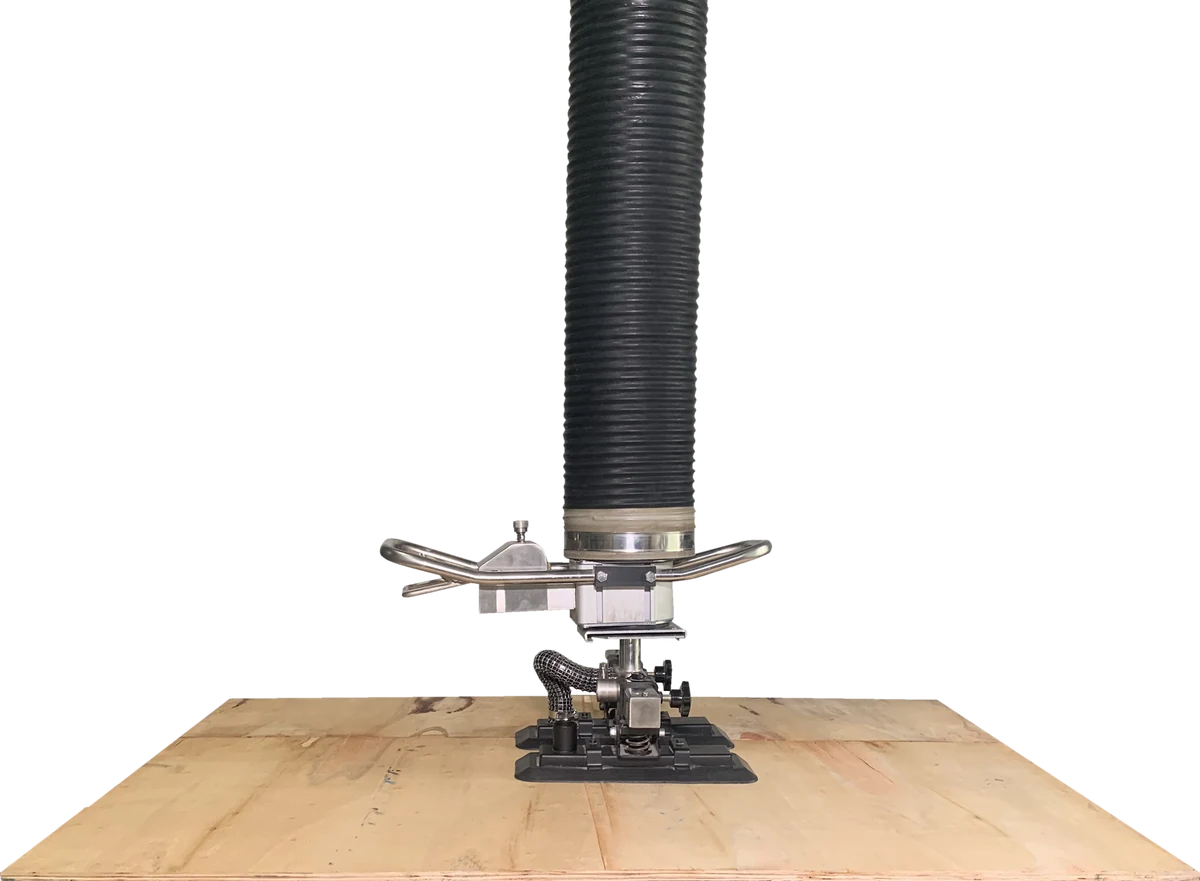
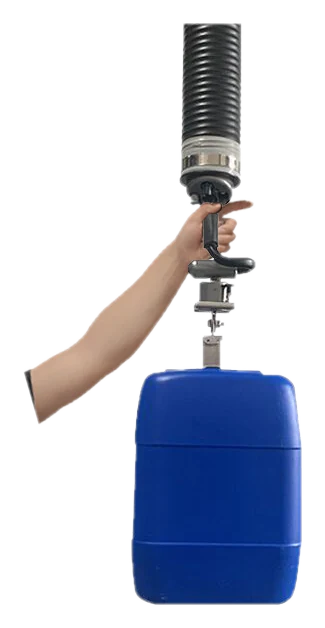
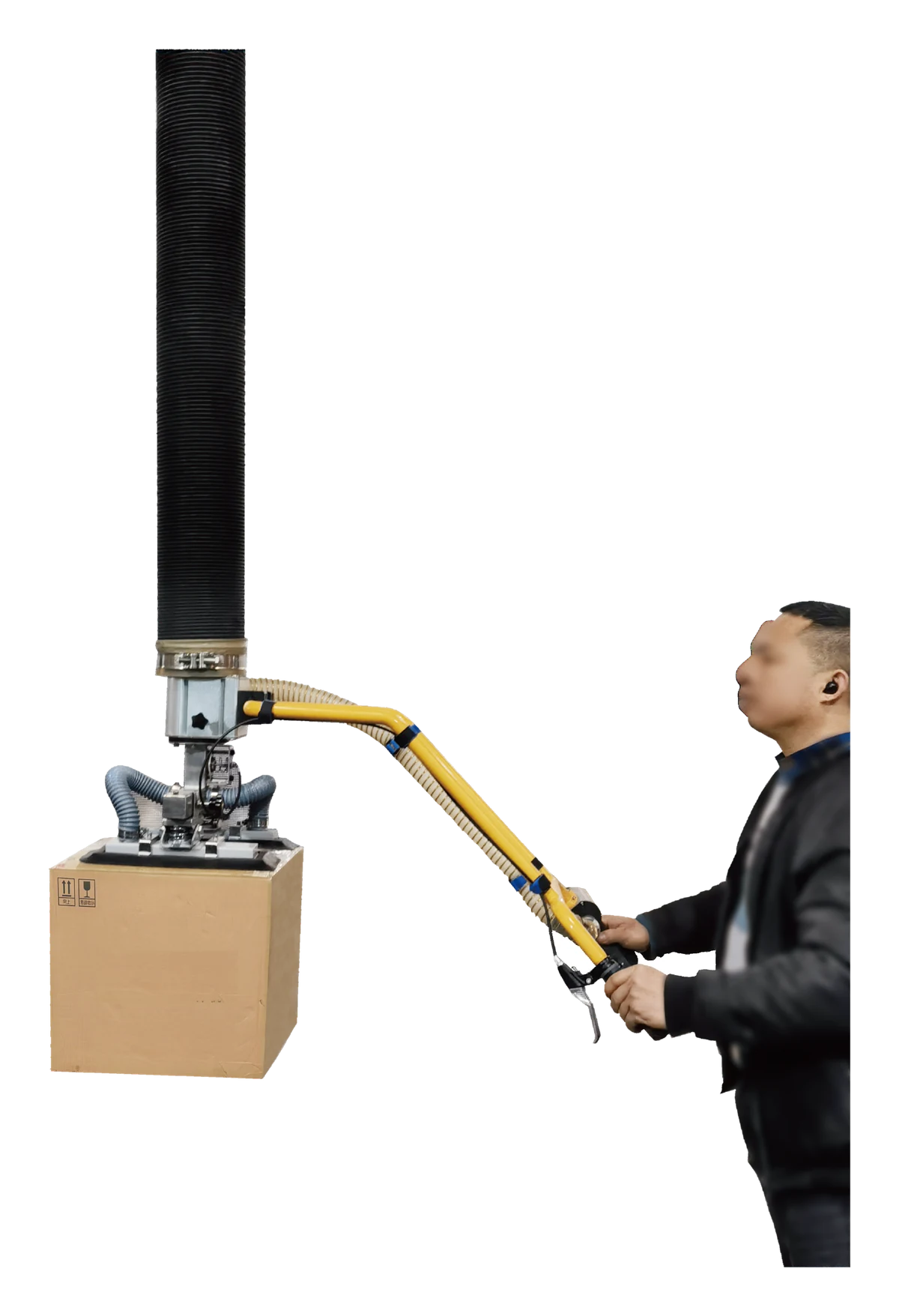
A vacuum tube lifter hangs from a jib crane or rail; one airflow grips the bag and lifts it, and the operator steers it onto the stack with a handle, so the person stays, the weight goes. Industry-wide, tube lifters cover roughly 20 to 300 kg; our own range runs from 25 to 200 kg.
A semi-automatic palletiser is a palletising machine that still needs an operator at the station. It is not in our range, and its rates, changeover and prices depend on the maker and the layer pattern, so this page gives no figures or ratings for it.
A collaborative palletising robot is an arm at the end of a line that places product without an operator. Published payloads for one maker's collaborative models are about 20 to 35 kg including the gripper, depending on model and mounting; the work is steady and can run unattended, but programming and integration are part of the price. This page gives no figures for other robot types.
Rate, flexibility and budget compared
| Route | Typical load | Rate | Flexibility | Relative cost | Suited to |
|---|---|---|---|---|---|
| Vacuum tube lifter with one operator | About 20–300 kg industry-wide; 25–200 kg in our range | Several lifts a minute is typical for short-distance palletising; some units are rated up to about 500 lifts an hour | High: change the pad, change the product; the tube works vertically only | Low to medium: a US dealer example from 2018 was about US$7,400 for the lifter plus about US$1,700 for a jib crane | Mixed products, frequent lifts, an operator who stays at the station |
| Semi-automatic palletiser | Set by the machine; not given here | Set by the machine; not given here | Set by the machine; not given here | Not given here | Not rated here |
| Collaborative palletising robot | About 20–35 kg payload, gripper weight included, depending on model and mounting (one maker's models) | Steady, unattended | Low to medium: programming and integration, costly when products change often | High | One product, end-of-line palletising |
The figures for the lifter and the robot come from published industry material and are estimates; the palletiser row is left without numbers rather than filled with guesses. Prices for our own models are given only in a quotation.
Next step: what moves the price of a lifter is explained in the vacuum lifter price guide.
When a vacuum lifter is enough
A lifter is the right answer when most of the following hold:
- Loads up to about 50 kg at several lifts a minute, which points to a single-handle lifter; heavier loads point to a two-handle lifter
- More than one product on the station: bags one day, cartons the next, handled by changing the pad
- Short moves between conveyor and pallet, where several lifts a minute is a typical rate
- A person is needed at the station anyway, for labelling, checking or feeding the line
- The load has a face that seals: closed sacks, taped cartons, drums; porous or open loads need special pads and a sample test
- A payback you can work out from your own wages, shifts and absence: months where the lifter takes a second person off a two-shift station, years where it does not
Next step: for cartons, see the vacuum box lifter page.
When to move to a semi-automatic palletizer or a robot
The lifter stops being the right answer when the station handles one product at the end of a line and has to run unattended, for example on a night shift; that is the pattern published for collaborative palletising robots. It also stops at the physics: loads above about 300 kg, off-centre loads that must be turned or pushed into a machine, and anything that must stay suspended for long are jobs for vacuum lifting devices under a hoist or for manipulators, not for a tube lifter.
Condition: a lifter changes product by changing the pad, while a robot cell needs programming and integration and becomes costly when products change often.
Layout of a lifter-assisted palletizing station
A pillar jib crane covers a sector of a circle: with a 0.5 m dead zone at the column, a 4 m arm slewing 270° covers about 37 m², and the crane moves most easily when the lifter works on the outer part of the arm, so the conveyor end and the pallets sit in that outer ring. Where several stations lie along a line, a rail system covers them and can be shared.
The stroke is checked against the stack: in the selection guide's sack example the lowest pick point is about 0.28 m and the highest place point 1.8 m, which with 0.2 m to clear the stack asks for a little more than 1.7 m of stroke, so the longer lifting height is chosen. On our ESL series the lifting heights are 1,700 and 2,500 mm. The clear height under the beam is checked against the factory drawing of the lifter and crane.
Condition: the floor under a pillar jib crane needs a foundation or a thick enough slab, checked by your engineer against the drawing supplied with the order. Next step: the full comparison of jib cranes, rails and mobile columns is on the lifting systems page, and the wider family of aids is on mechanical aids for manual handling.
FAQ
How many bags an hour can one operator palletise with a vacuum lifter?
Cycle time depends mainly on travel distance and placing accuracy; several lifts a minute is common for short-distance palletising, as a typical figure rather than a promise. We estimate throughput only from your actual layout.
We run the station with two people; does one lifter replace one of them?
On heavy sacks that two people carry together, a lifter lets one person do the job; that is the industry's worked example with a payback of about 7 months, which depends on your own wages and shifts. Where one person already works alone, the lifter changes the strain and the absence, not the headcount.
Scope
What this page does not cover
We do not make palletisers or palletising robots; the robot figures on this page are one maker's published data, not ours; loads above 200 kg are outside this site's range; the examples on this page are the industry's worked examples, not customer cases.
Cowest Machinery designs and manufactures vacuum tube lifters at its factory in Qingyuan, Guangdong, China.