Buying guide
Vacuum tube lifter price: what is included and what drives it
Compiled from public standards and manufacturers' published data.
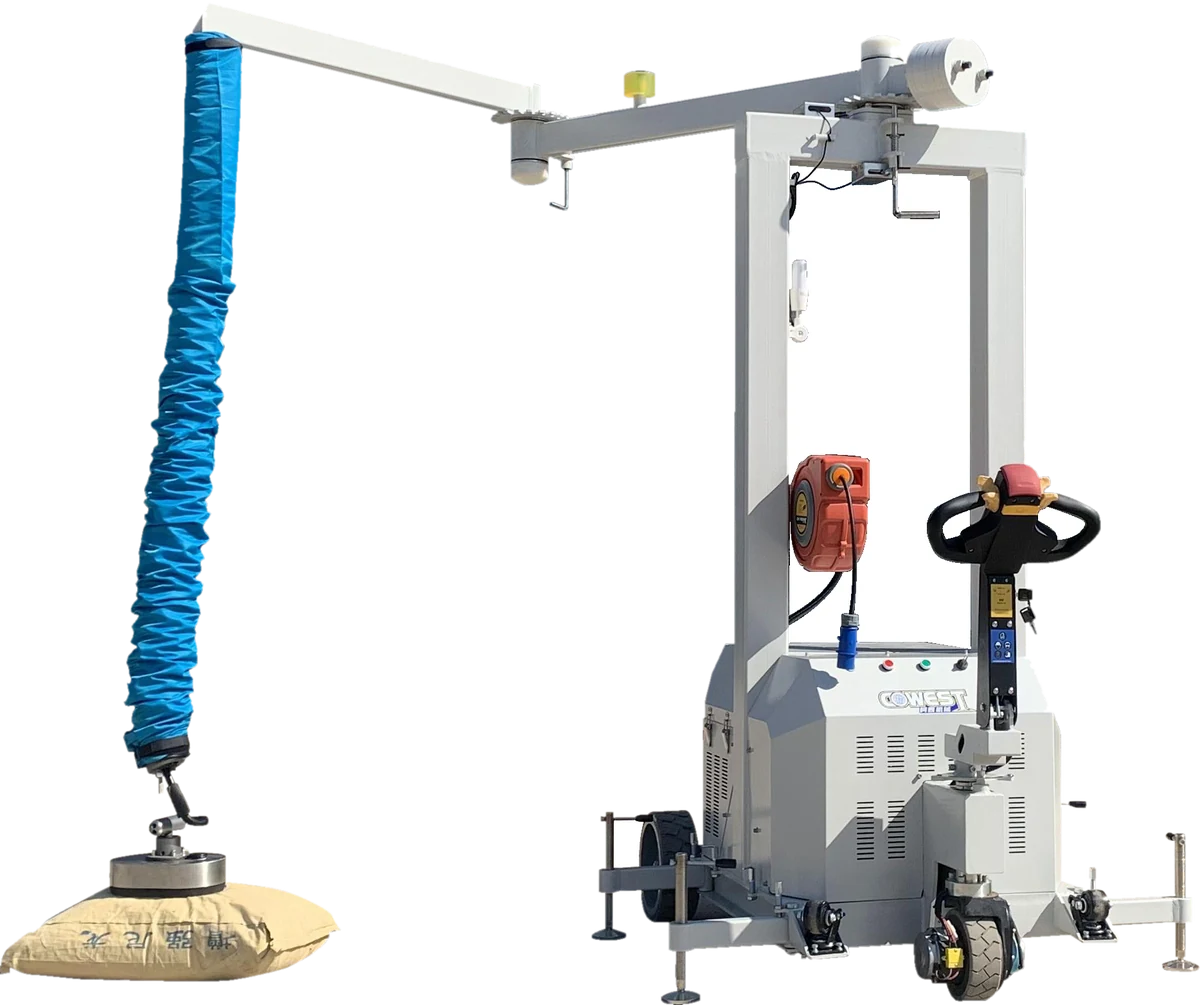
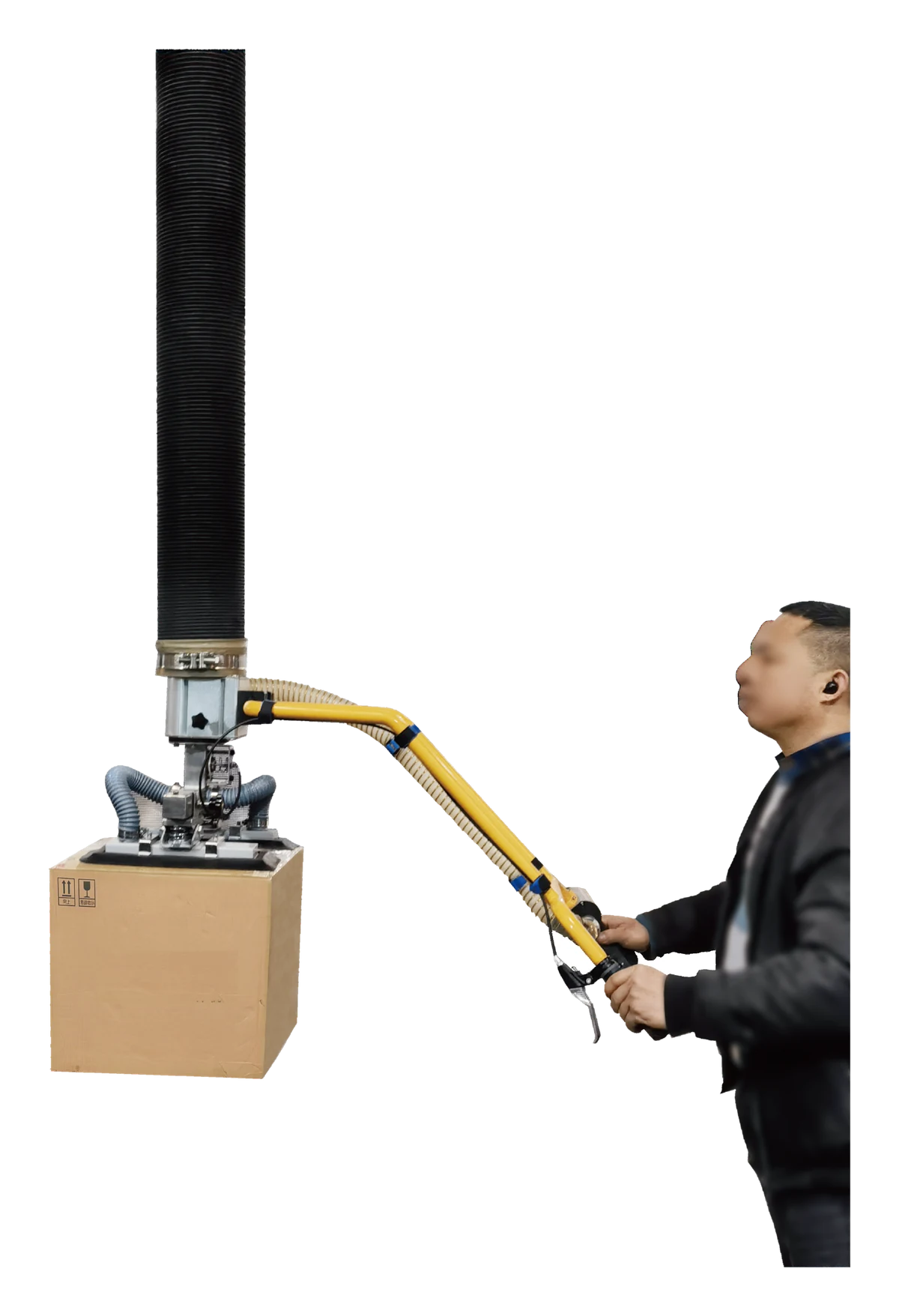
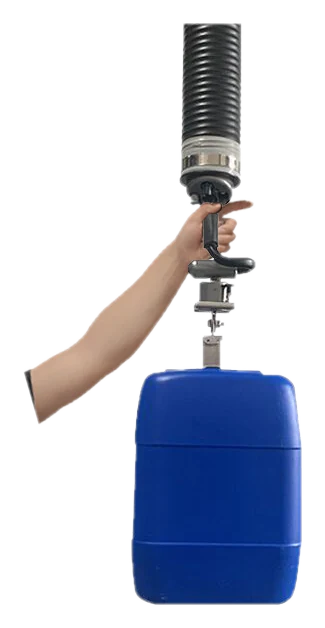
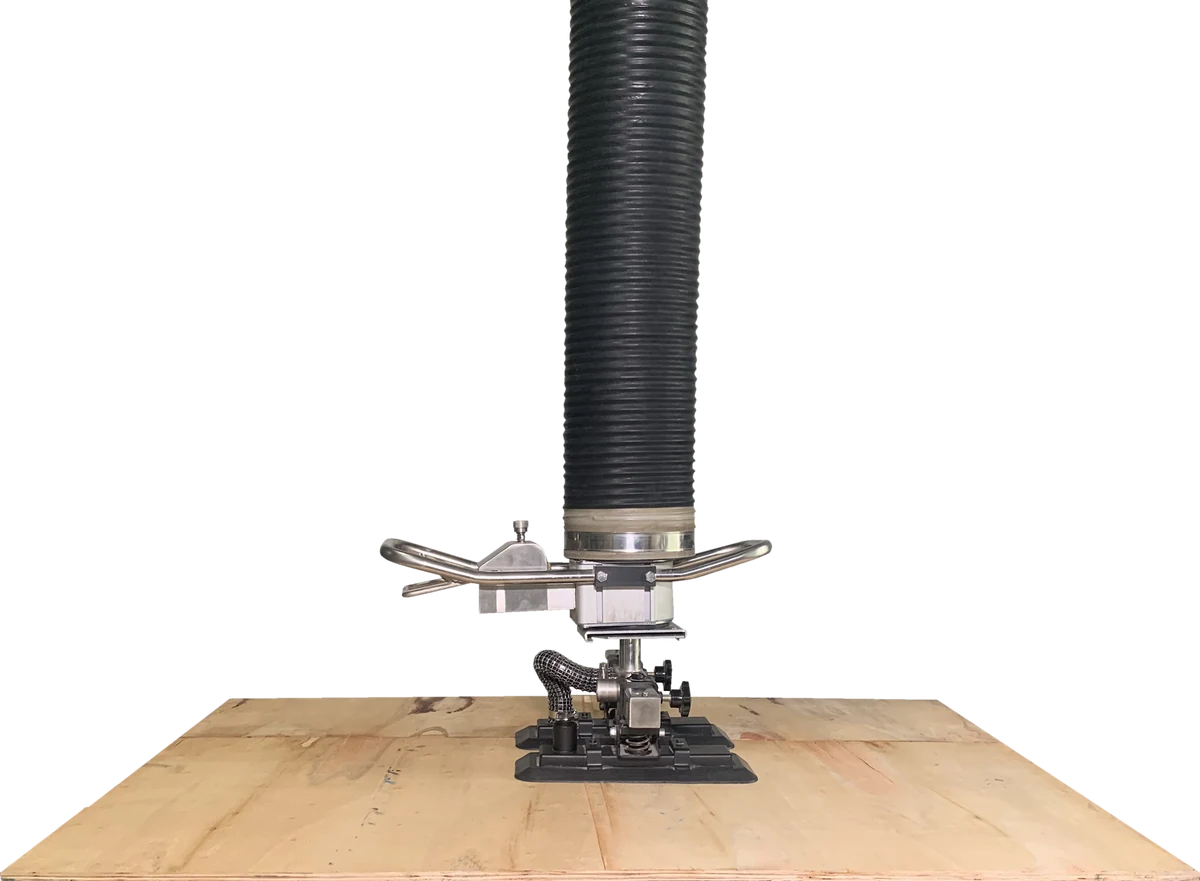
The price of a vacuum tube lifter is rarely the price of the lifter alone: the pad, the crane, the voltage, the spare parts and the documents decide what the quotation adds up to, and the trade term decides what is left out. This page gives the ranges seen in the market, the line items a complete quotation should carry, and what moves the number, so that you can compare quotations on the same basis. It is about crane-mounted tube lifters for sacks, cartons and drums, not hand-held suction cups or glass lifters; our own vacuum tube lifter range is quoted on request.
What a vacuum tube lifter costs: ranges, not quotes
Market signals, not quotations: in September 2026, Chinese-made tube lifters were listed on B2B platforms at roughly US$1,100 to US$19,500, most between about US$2,000 and US$12,000 FOB; platform list prices are not transaction prices, and a single listing often carries tiered prices that differ several times over. Price signals for imported brands from US retail and dealer sources: a bag lifter without crane at about US$7,425 from a US dealer in 2018, a mobile tube lifter listed at about US$21,257 in a US online store, and a used premium unit with crane at about US$12,500. Premium brands do not publish complete system prices; dealers quote.
Compare on the same basis: a premium brand's price to the end user includes dealer margin, installation and service; a factory list price includes none of them. Our prices are stated in the quotation for your configuration and are not published on this page.
Next step: the ranges tell you whether a quotation is in the market; the next section tells you whether it is complete.
What a quotation includes
| Line | What it should state | Needed |
|---|---|---|
| Lifter: vacuum generator, lifting tube, handle | Rated capacity, tube size, lifting height, generator power | Always |
| Pad or gripper | Type for your load; one in use and one spare is common | Always |
| Crane or rail | Pillar jib, wall jib or rail, with arm length and height | As required |
| Electrical | Voltage, frequency and plug standard matching the destination | Always |
| Spare-parts kit | Tube, filter cartridges, pad seals | Strongly recommended |
| Documents | Declaration of conformity, manual in the local language and any other document the market requires | Always, per market |
| Pre-shipment inspection | Third-party inspection | Recommended |
| Packing | Export plywood case | Always |
| Freight and insurance | Under CFR or CIF terms | Per trade term |
On our range the lifter line is one of the ESL-SG, ESL-MD or ESM models, the crane line a WJC pillar jib crane or AM aluminium rail, and the electrical line 380 V three-phase as standard with other voltages on request. Our vacuum tube lifters are CE marked, with Attestation of Conformity No. CE-1629-01-011123 (CGS Test, valid to 2028) available on request; the documents supplied with a specific model and market are listed in the quotation. Next step: see what carries a lifter on the lifting systems page.
What drives the price up or down
- Capacity and tube size: a 200 kg two-handle lifter with a 5 kW blower costs more than a 35 kg single-handle unit with 2.2 kW
- Lifting height: 2,500 mm instead of 1,700 mm on the ESL series
- Pads: the number of pad types, special pads for porous or odd loads, and spares
- Crane: a 4 m arm on a 4.5 m column against a 2.5 m arm on a 3 m column, 250 kg class against 125 kg class; a rail system against a jib crane
- A voltage or frequency other than the standard 380 V three-phase, on request
- Spare-parts kit, pre-shipment inspection and document pack
- Trade term: freight and insurance move between the quotation and your own costs; import duty and taxes stay on your side under FOB, CFR and CIF
How to lower cost without losing capacity: size the lifter from a sample test rather than adding a model for safety, choose the 1,700 mm lifting height where the stack allows, put the station in the outer part of a jib arm rather than buying a rail for one position, and order the spare-parts kit now rather than airfreighting a seal later. Next step: the selection guide explains the sizing.
FOB, CFR, CIF: what is and is not in the price
| Term | Included in the price | Your side | Note |
|---|---|---|---|
| FOB | Goods on board at the Chinese port | Sea freight, insurance, import clearance and duty, inland delivery | Usual term; risk passes on loading |
| CFR | Goods plus sea freight to your port | Insurance, clearance, duty, inland delivery | Risk still passes on loading |
| CIF | Goods, sea freight and insurance | Clearance, duty, inland delivery | Risk still passes on loading |
| EXW | Goods at the factory | Everything, including export clearance | Used with care |
| DDP | Not covered on this page | — | Under DDP the seller becomes the importer of record, with the destination country's product-compliance, tax-registration and product-liability duties; ask before you plan on it |
Import duty and taxes depend on the destination country and are not part of a factory quotation; your broker gives the figure for your tariff line. Next step: tell us the port and the term you want in the enquiry.
Payment terms
Common practice for tube lifters bought from China is a deposit by bank transfer with the balance paid before shipment or against a copy of the bill of lading, or a sight letter of credit; new distributors and high-risk regions usually see tighter terms. Export-compliance practice is for payment to come from the contracting buyer itself. Both are industry practice, not our terms. What we offer on payment, lead time and warranty is written into the quotation for your order.
How to get an accurate quote
A quotation is only as accurate as the enquiry: load and packaging, maximum weight, dimensions, porosity, pick and place heights, lifts per hour, clear height and working radius, power supply, destination and trade term, and whether the area is a classified zone. With those, the first reply can be a proposal rather than questions.
Scope
What this page does not cover
Rental is not offered; DDP is not covered on this page; on this site, prices for our models are given in a quotation.
Cowest Machinery designs and manufactures vacuum tube lifters at its factory in Qingyuan, Guangdong, China.