Load guide
Can a vacuum lifter handle porous paper and woven sacks?
Compiled from public standards and manufacturers' published data.
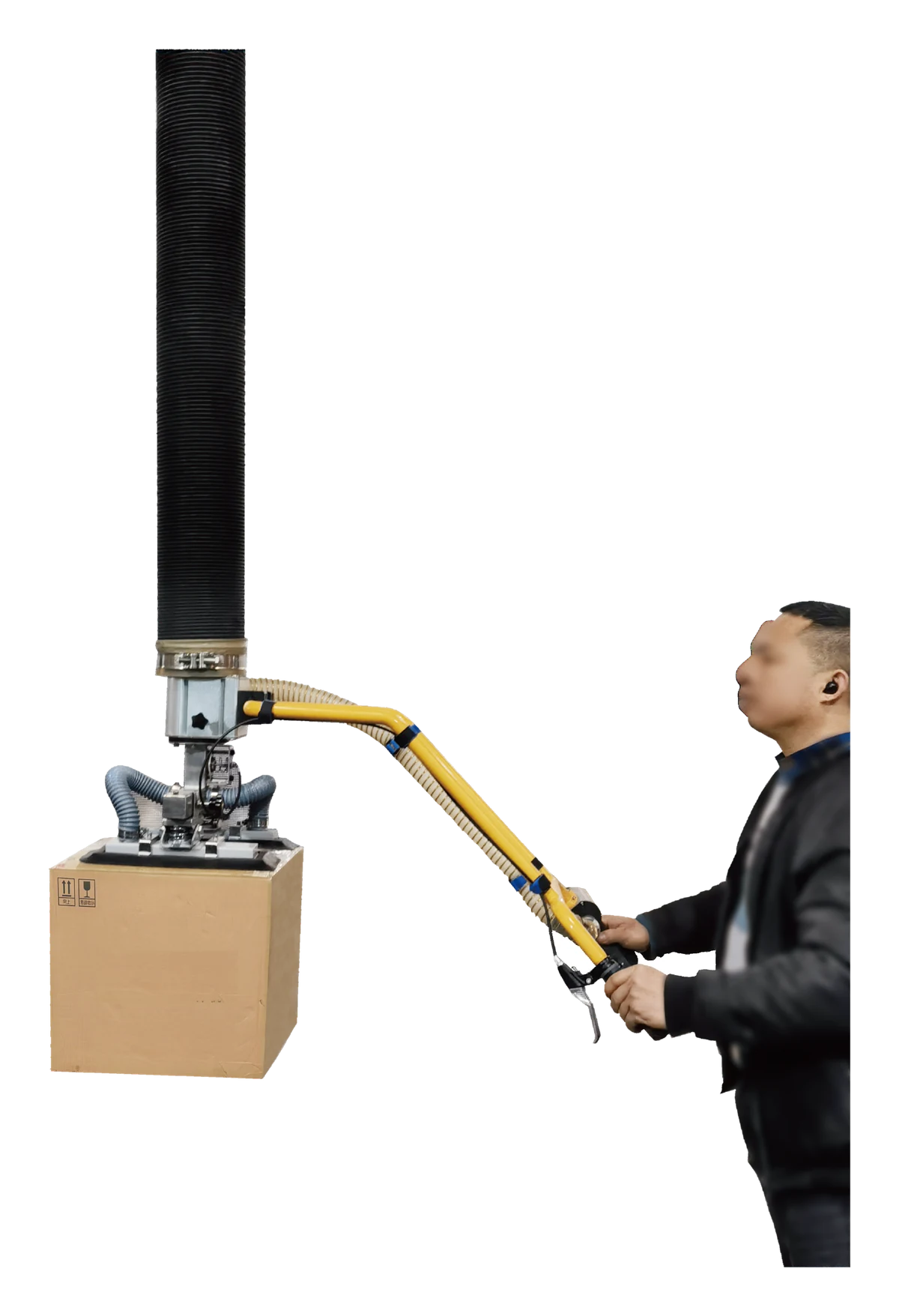
Usually yes for paper sacks, often not for uncoated woven sacks, and never without knowing which. A vacuum lifter for paper bags grips and lifts a paper sack the same way as an airtight load, but a porous sack leaks air through its surface, so the lifter has to make up the leak and the usable capacity drops. This page explains why, how much to expect by bag type, why blower flow matters more than tube size, which pads help, and how the sample test settles it before you order. It is written for the sacks among the load types we handle.
Why porous sacks lose capacity
A vacuum tube lifter lifts because the vacuum generator keeps the pressure inside the lifting tube below the air pressure outside; the difference, acting on the tube's cross-section, contracts the tube, and the same difference holds the pad on the load. With an airtight load, such as a PE film bag, the generator only has to hold that pressure difference. With a porous load, air streams in through the sack wall the whole time, and the generator has to move that air out again while keeping the pressure difference; the more the sack leaks, the lower the pressure difference the generator can hold, and the lower the lifting force.
That is why the same lifter lifts less of a paper sack than of a film bag, and why a sack that is too porous cannot be lifted by vacuum at all: at some point the generator cannot keep up with the leak. Porosity is therefore the first question in every sack enquiry, before weight.
Porosity classes and derating
For planning, sacks fall into four porosity classes; makers publish capacities for airtight, semi-porous and porous loads, and the shares below are planning estimates drawn from such data, not test results.
| Class | Typical sacks and loads | Planning capacity | Consequence |
|---|---|---|---|
| Airtight | PE film bags, stretch-wrapped goods, plastic and steel drums | 100% | Sized on the catalogue rating |
| Semi-porous | Paper sacks with a PE liner, laminated (coated) woven sacks, plain corrugated cartons | 75–90% | Good seal; moderate derating |
| Porous | Unlined multi-wall paper sacks, chipboard | 50–80% | High-flow vacuum source, larger pad, soft seal; sample test |
| Highly porous | Uncoated woven PP sacks, jute, cloth and mail bags | Often not on vacuum alone | Test first; a mechanical sack gripper or a double bag hook is the usual industry alternative |
Worked example (estimate): a 25 kg unlined paper sack planned at 50–70%, the usual first estimate for paper sacks, needs a lifter rated for 36–50 kg on airtight loads; a 50 kg lined sack planned at 75–90% needs 56–67 kg. Our ESL ratings are catalogue values for airtight loads; porous sacks are tested with samples before the model is confirmed.
Next step: the models and pads we recommend by sack weight, and how to apply the derating to them, are on the vacuum bag lifter for paper sacks page.
Flow beats vacuum level
Two figures describe a vacuum generator: the vacuum level it can reach, and the volume of air it moves per hour. An airtight load needs vacuum level; a porous load needs flow, because flow is what replaces the air leaking in. One maker's published capacity chart lists the same tube lifter with two pump sets: the set that was stronger on airtight loads lost about 51% of its capacity on porous loads, the other lost only about 19%.
Why a bigger tube does not fix a leak: capacity rises with tube cross-section only if the pressure difference can be held, and the leak is set by the sack, not the tube; a larger tube with the same generator leaks the same and costs more. A larger pad does not raise capacity either, since capacity comes from the tube and the vacuum level; the pad's job is to seal. The right move for porous sacks is a higher-flow generator, a pad that seals better, and a sample test.
Condition: on our ESL range the blower is fixed by the model, from 2.2 to 5.0 kW depending on the model; for porous sacks the model, and with it the blower, is confirmed from the sample test. Next step: the sizing method, step by step, is in the 5-step selection guide.
Pads for porous sacks
On a porous sack the pad has two jobs: seal against a surface that is neither flat nor airtight, and hold a sack that sags and creases. The industry answers are a larger pad than for an airtight load, a soft foam or rubber skirt seal that follows the sack surface, a support grid that keeps a slack sack from being drawn into the pad, and a filter fleece that keeps dust out of the generator.
| Measure | What it does |
|---|---|
| Larger pad than for an airtight load | Industry practice for porous loads, usually with a rubber skirt |
| Soft foam or rubber skirt seal | Follows creases and an uneven surface |
| Support grid in the pad | Stops a slack, half-filled sack from being drawn in and the seal from breaking |
| Filter fleece or dust filter | Keeps sack dust out of the generator |
| High-flow generator | Makes up the leak |
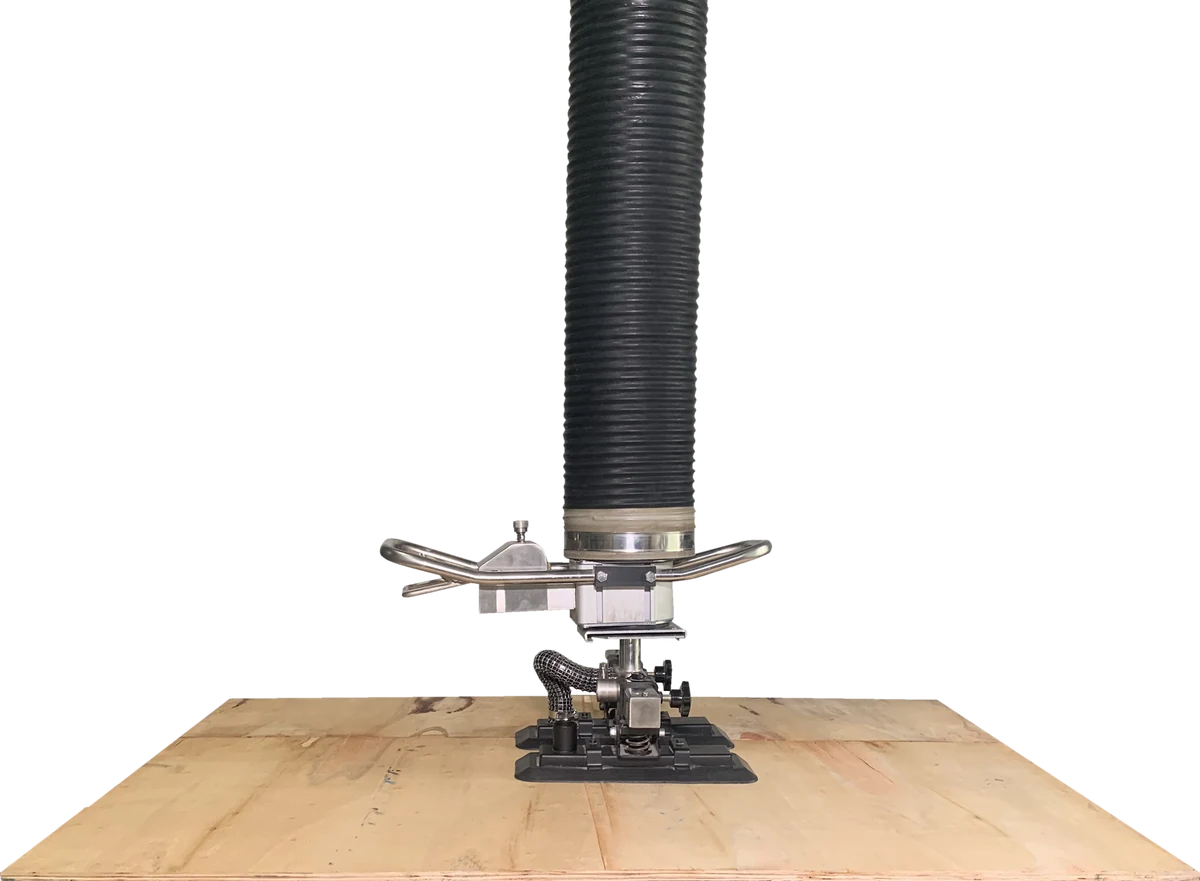
Our sack pads: SUS190×290R with the ESL-SG120/22, and SUS230×380R with the ESL-SG140/22, 160/30 and 180/30 and the ESL-MD140/22, 160/30 and 180/30. The sack pad for the ESL-MD200/40 and above, whether a support grid or a skirt seal is fitted, and the seal material are confirmed in the quotation.
Next step: for 25–50 kg sacks and for tilting, with the tilt rating confirmed in the quotation, the two-handle ESL-MD two-handle lifters are the series our bag page recommends.
The sample test
For porous sacks the test replaces the estimate: you send 3–5 of the actual sacks, filled as they are in production, to our factory; we lift them on a lifter and pad of the proposed size and send you the test video before you order. The test settles the usable capacity, the pad size, and whether a support grid or a skirt seal is needed, and the quotation states which load class the rating applies to.
- 1. Tell us the sack: material, liner or coating, weight, dimensions, fill level, and the pick and place heights
- 2. Send 3–5 filled sacks to the address we give you; test conditions are agreed in advance
- 3. We lift them on the proposed model and pad and record it
- 4. You get the video and the result; the quotation states the load class the rating applies to
describe the sack in the form and we reply with the test arrangement.
FAQ
Can a vacuum lifter lift woven polypropylene sacks?
Coated (laminated) woven sacks usually can, as a semi-porous load; uncoated woven sacks, jute and cloth bags are so porous that vacuum alone often cannot hold them, and the industry uses a mechanical sack gripper or a double bag hook instead. If the coating is unknown, send samples; we do not quote a vacuum pad for an uncoated woven sack without a test.
What about wet, dusty or oily sacks?
Loose material on the surface leaks air and can let a load drop; wet or oily surfaces do the same to the seal. The industry answers are a clean surface, an oil-resistant seal with a friction pad for oily loads, or a mechanical gripper; a dusty sack also calls for a filter fleece and a shorter filter-cleaning interval.
Will a bigger tube or a bigger pad solve it?
No. The leak belongs to the sack: a larger tube with the same generator still cannot hold the pressure difference on a leaking sack, and it is heavier and costs more; a larger pad does not raise the capacity of the lifter. Flow, seal and a test are what help.
What happens to a sack if the power fails?
Tube lifters in this industry usually have a non-return valve, so the load lowers slowly rather than drops when the power fails; the behaviour of a specific model is described in its manual, and nobody stands under a suspended load at any time.
Scope
What this page does not cover
Mechanical sack grippers and double bag hooks, the industry's usual alternative for highly porous sacks, are outside this page; so are loads above 200 kg and glass and stone vacuum lifters, both outside this site's range; and explosive atmospheres, as we do not offer explosion-proof versions.
Cowest Machinery designs and manufactures vacuum tube lifters at its factory in Qingyuan, Guangdong, China.